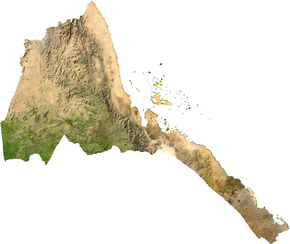
Eritrea
Eritrea is a small, coastal country located in the Horn of Africa, bordered by Sudan to the west, Ethiopia to the south, and Djibouti to the southeast, with the Red Sea to the east. Known for its strategic location along the Red Sea, Eritrea boasts a long history that includes ancient civilizations, such as the Axumite Empire, and its role as part of the Italian colonial empire in the 19th and 20th centuries. The capital, Asmara, is famous for its well-preserved colonial-era architecture, including art deco buildings that have earned it UNESCO World Heritage status.
Eritrea is ethnically diverse, with nine recognized ethnic groups, including the Tigrinya, Tigre, and Afar. It is a multilingual country where Tigrinya, Arabic, and English are widely spoken. The country has a mixed religious population, primarily split between Christianity (mostly Eritrean Orthodox) and Islam. Eritrea’s economy is primarily based on agriculture and mining, particularly gold and copper.